
AI carousels — 8 min
Create carousels across social networks, from 2 to 10 pages
My Post Factory turns a generated post into a structured carousel: the AI distributes the message across slides, creates a logical progression and can use your images for branding or to show a different product on each page.
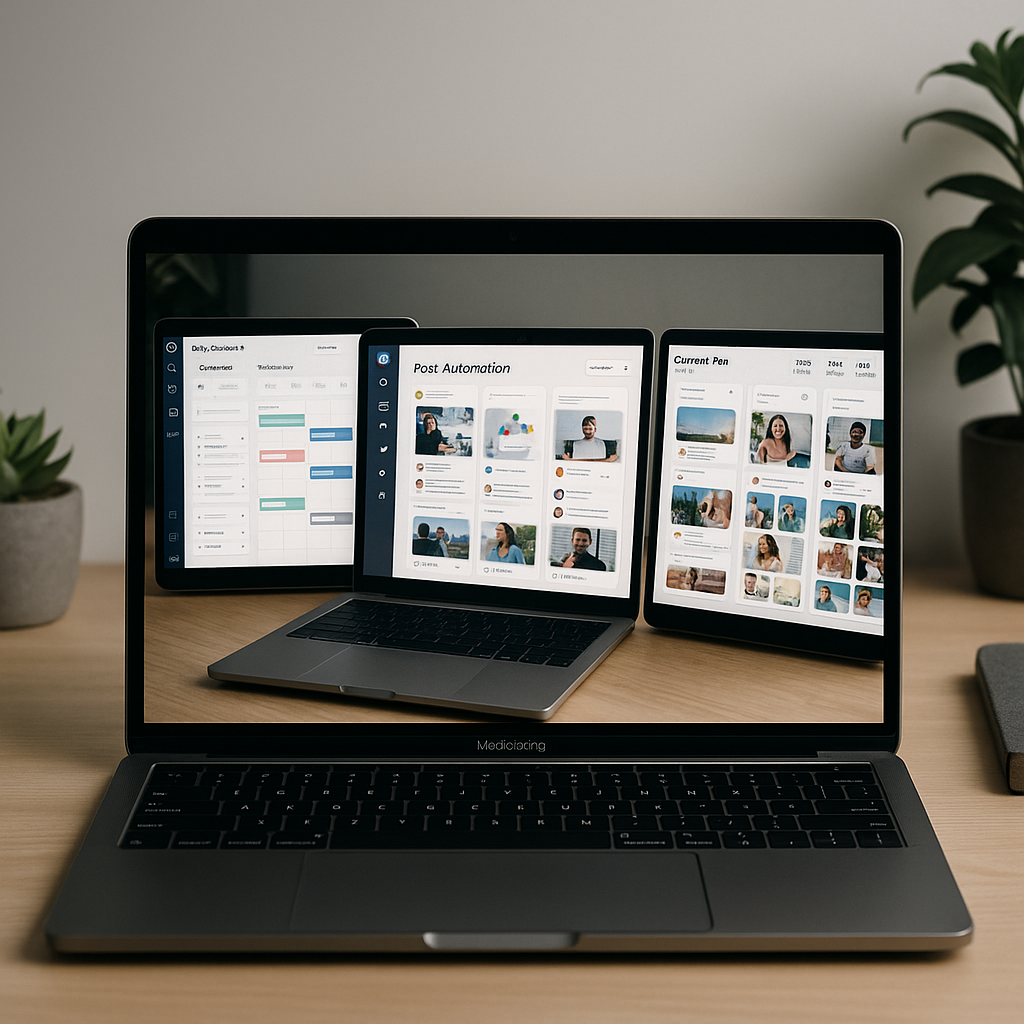
- Pillar page for social media carousel, AI carousel, LinkedIn carousel and Instagram carousel keywords.
- Explains the product mechanics: 2 to 10 pages, automatic split and logical slide sequence.
- Connects branding, one product per slide and multi-network publishing use cases.
The carousel is no longer limited to one network
The carousel format has become a simple way to make content richer without turning everything into video. LinkedIn uses it for structured ideas, Instagram for visual stories, Facebook for multi-image posts and other networks for extending a message.
The need is similar everywhere: not only publishing an image, but moving the reader or viewer through a sequence.
That is why My Post Factory treats the carousel as a real content format, integrated into the generation and publishing workflow.
A strong multi-network carousel is a logical sequence, not a folder of images placed one after another.
How AI splits the post into slides
The starting point remains the generated post: an idea, angle, promise, example or product message. The AI then identifies the important blocks and distributes them according to the selected number of pages.
Each slide gets a function. The first one hooks, the following slides develop, show or prove, and the last one closes. This creates a smoother reading experience than splitting text mechanically by length.
The 2 to 10 page range provides a simple frame. It avoids carousels that are too long, hard to review and rarely needed for regular publishing.
- Detection of the central idea
- Distribution into readable steps
- Adaptation to the chosen page count
- Coherence between text, visual and CTA
Why start with 2 to 10 pages
The 2 to 10 page limit is intentional. It makes carousels rich enough to be useful, but short enough to publish regularly.
Two pages are enough for a contrast. Three pages create a short explanation. Four pages can carry a framework. Five pages give enough room for a mini product story, short guide or comparison.
That constraint also helps the AI: it forces prioritisation instead of stretching the content artificially.
A shorter, sharper carousel is better than a long sequence of redundant slides.
Images for branding and products per slide
Reference images give the carousel a stronger visual foundation. They can communicate brand universe, mood, colors, composition or expected level of finish.
They can also support product presentation. In that case, each carousel page can use a different image to present an item, offer, variant or benefit.
This matters for e-commerce catalogues, product brands, restaurants, creators, SaaS product screenshots and any team that needs to show something concrete.
Adapting the same topic to LinkedIn and Instagram
The same substance can live differently depending on the network. On LinkedIn, the carousel will usually emphasise structure, expertise and logical progression. On Instagram, it often needs to be more visual, direct and image or product led.
My Post Factory can handle that adaptation because the format is linked to the selected network inside the automation. The carousel is not created out of context.
That prevents the common mistake of creating one piece of content and forcing it everywhere. The topic can stay shared while the execution respects the channel.
The LinkedIn carousel and Instagram carousel should not be identical. They should start from the same strategy and respect their channel.
What this changes for content production
Without automation, the carousel is often an exceptional format: reserved for a campaign or a day when the team has time. With an AI workflow, it can become recurring.
The gain is twofold: more variety in publications, and less work to turn each idea into multi-page content. Teams can test more angles without opening a full design task every time.
That is exactly My Post Factory’s role: moving carousels from special content to a normal format inside a multi-network strategy.
Add carousels to your content machine
When the format is part of the workflow, you can publish LinkedIn, Instagram and multi-network carousels without producing every slide by hand.